Publications / 2026
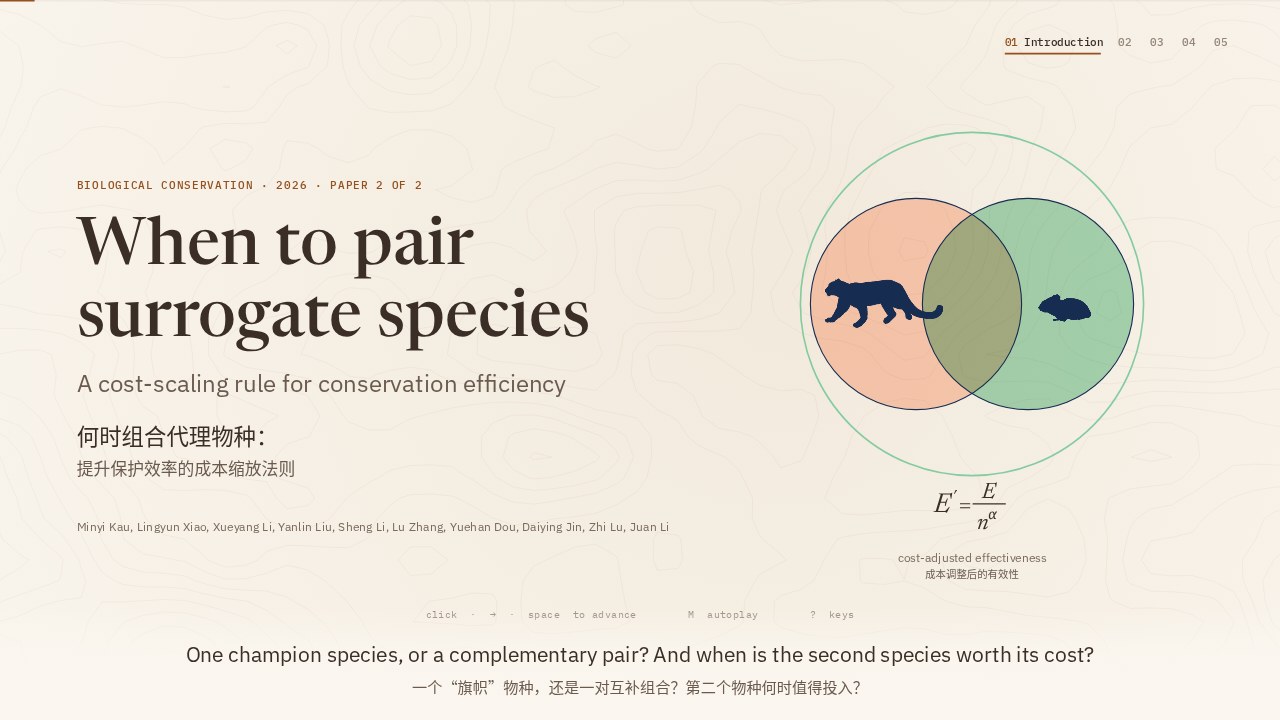
When to pair surrogate species: A cost-scaling rule for conservation efficiency
Highlights
- Cost-scaling rule defines when pairing surrogate species is efficient.
- Iconic flagships show diminishing marginal gains, limiting partner benefits.
- Habitat and trophic complementarity drive large, dimension-specific gains.
- Provides an efficiency threshold tool to support global biodiversity targets.
Abstract
Conservation's US$700 billion annual funding shortfall demands efficient surrogate strategies, yet managers lack guidance on when a single champion species suffices versus when a complementary pair is needed. We present a general cost-scaling framework for surrogate portfolio selection and demonstrate it with 435 single- and two-species portfolios from 29 endemic mammals in China's Three-River-Source National Park. Using multi-criteria decision analysis, we integrated umbrella (habitat coverage), keystone (food-web centrality), and flagship (regional search interest) roles and quantified how habitat, trophic, and public-attention complementarity translated into incremental gains. By sweeping a coordination-cost exponent (α), which governs how costs scale with portfolio size, we identified the efficiency threshold (α*) beyond which the best singleton outperforms all pairs. Habitat complementarity increased umbrella coverage by a median of 41% and trophic complementarity boosted food-web centrality by 16%, whereas flagship gains showed diminishing returns when attention was already concentrated on a dominant species, with all pairings involving the dominant flagship adding ≤5% in this system. In this case study, α* ≈ 0.56, meaning pairs outperformed singletons only when managing two species cost ≤1.5 times managing one—a simple screening rule for this system: pair below α*, streamline above. This numerical threshold is specific to the TRSNP assemblage; the transferable contribution is the framework for deriving locally calibrated thresholds in other systems. The approach supports Target 4 (halting species extinctions and reducing extinction risk) and can inform spatial prioritization under Target 3 (conserving 30% of land, waters, and seas) of the Kunming–Montreal Global Biodiversity Framework.
论文原文为英文,摘要保留英文原文。
Companion paper